
News & Articles

OUR BLOG

Latest news & articles

Our blog is your go-to resource for news, insights, and articles on ADHD, education, personal growth, and more. Here, you’ll find expert advice, inspiring stories, and practical tips to help you navigate life’s challenges and celebrate your unique strengths.

Encouragement

The More We Meet, the More We Unmask

Black Women, ADHD, and the Quiet Work of Deconditioning (Unlearning) There is a moment that happens in long-term coaching work—often not in the first session, and rarely in the second—when something shifts. A client pauses mid-sentence. Their shoulders drop without explanation. The urgency to sound competent, prepared, or “on top of it” softens. What emerges in that moment isn’t disengagement. It’s regulation. I’ve come to recognize this shift not as a breakthrough, but as a signal: safety has accumulated. Showing Up Fully Is Part of the Work As a proud Black neurodivergent woman, I don’t come into sessions detached from who I am. I see it as a responsibility to show up fully—and intentionally. Not performatively. Not as a strategy. But as a practice. I model regulation without pretending it’s constant, and honesty without abandoning care. That choice matters more than we often acknowledge. Because clients don’t just respond to tools, frameworks, or strategies—they respond to what is consistently embodied in the room. When the person holding the space isn’t performing perfection, others don’t feel pressured to either. ADHD Does Not Exist in a Vacuum In my work with Black women with ADHD, it becomes clear very quickly that the challenges we’re navigating are not just about attention, focus, or follow-through. They are shaped by years—often decades—of conditioning. Conditioning to be strong. Conditioning to be reliable. Conditioning to hold it together, no matter the cost. Many of the women I work with arrive wanting better systems, more consistency, or clearer routines. What they often discover instead is how much energy they’ve been using just to maintain an identity built around endurance. This is where deconditioning—unlearning—becomes central to the work. Deconditioning Is Relational Deconditioning is not about dismantling identity. It’s about unlearning survival-based patterns that once protected us but now constrain us. And it doesn’t happen in isolation. It happens in relationship—through repeated experiences of being met without urgency, correction, or expectation. Over time, clients begin to notice subtle shifts: They stop overriding their bodies to meet external demands. They question the belief that inconsistency equals failure. They begin to rest without explaining or justifying it. These changes aren’t forced. They aren’t assigned. They emerge because the space no longer requires performance. Unmasking Is a Byproduct of Safety Unmasking is often described as a bold, decisive act. In reality, it’s quieter than that. It happens gradually, session by session, as the nervous system learns something new: I don’t have to earn care here. I don’t have to translate my exhaustion. I don’t have to be strong to be respected. When safety is consistent, the mask loses its function. Not because it’s taken away—but because it’s no longer needed. What remains isn’t dysfunction. It’s alignment. My Own Ongoing Practice This work is not something I facilitate from a distance. As a Black neurodivergent woman, I am engaged in my own process of deconditioning and unlearning—especially in spaces that once rewarded over-functioning and emotional containment. I know how tempting it is to lead with clarity instead of presence. To intellectualize instead of feel. To default to competence because it has always been praised. But I’ve learned that when I choose visibility over polish, I’m not losing authority—I’m redefining it. That modeling isn’t incidental. It’s ethical. Liberation Without Performance Liberation, I’ve learned, doesn’t come from mastering ADHD. It doesn’t come from optimizing every system or perfecting every routine. It comes from being supported without performance. From being witnessed without being reshaped. From returning to the same space again and again and being allowed to arrive differently each time. Not more efficient. Not more resilient. Just more honest. And that freedom doesn’t arrive all at once. It arrives session by session. Truth by truth. Exhale by exhale. Reflection Question: Where have you noticed that safety—not pressure—created real change in your life or work?

Read More »
Encouragement

ADHD, FOMO, and Sleep: Understanding the Connection (Summer Edition)

Summer is its own social animal. With school out, long sunny evenings, and a million group chats buzzing about rooftop gatherings, beach trips, and spontaneous cookouts—FOMO (Fear of Missing Out) turns up the heat. And for ADHD brains, this season can completely derail any chance of decent sleep. That’s why I’m bringing this blog back out. And this version was inspired by my youngest client. ❤️ She’d been staying up until the wee hours, trapped

Read More »
Encouragement

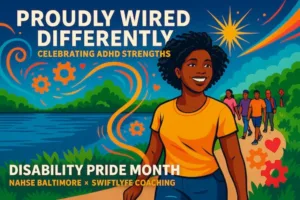
Proudly Wired Differently: Reframing ADHD & Mental Health-Disability Pride Month

On July 12th, I had the honor of being the guest speaker for the National Association of Health Services Executives (N.A.H.S.E.) Baltimore Chapter’s community walk at Lake Montebello—a powerful gathering that blended mental health advocacy, movement, and meaningful dialogue. As someone living with ADHD and working at the intersection of education, coaching, and expressive arts, I’ve learned to see my neurodivergence not as a barrier, but as a blueprint. I was invited to speak as part

Read More »
Encouragement

ADHD and Fatigue: Why You’re Always Tired and What to Do About It

By Shayne Swift | SwiftLyfe Coaching & Consulting Feeling Exhausted with ADHD? You’re Not Alone. Picture this: you wake up already tired. Your brain feels like a browser with 37 tabs open—and at least 20 are frozen. You sip your coffee, glance at your to-do list, and think, Why does everything feel so hard? If you’re living with ADHD and chronic fatigue, this isn’t just in your head. Fatigue is one of the most common

Read More »
Articles

5 ADHD Women Who Changed the World: Proof That ADHD Is a Superpower

For too long, ADHD has been misunderstood—especially in women. Many of us grow up feeling “too much” or “not enough”, struggling with focus, organization, and self-doubt while being overlooked or misdiagnosed. But here’s the truth: ADHD is not a weakness—it’s a superpower. Some of the most brilliant, creative, and game-changing women in history have ADHD, and their stories prove that thinking differently is an advantage, not a limitation. Let’s celebrate five incredible ADHD women who

Read More »
Articles

How to Overcome ADHD Procrastination and Get Things Done

ADHD and procrastination often go hand in hand. If you’ve ever found yourself staring at a to-do list, feeling overwhelmed, and putting things off until the last minute—you’re not alone. But here’s the truth: procrastination isn’t laziness. It’s a dopamine regulation issue. Understanding why ADHDers procrastinate and learning how to work with your brain (instead of fighting against it) can help you break free from the cycle of frustration and shame. Let’s dive in. Why

Read More »
Articles

Turning Self-Love into a Habit – Sustainable ADHD Routines

Introduction Self-love isn’t a one-time event—it’s a practice. But for ADHDers, keeping habits consistent can feel impossible without the right strategies. Struggles with executive function, motivation, and structure often make sustaining self-care routines an ongoing challenge. However, by understanding the barriers and implementing ADHD-friendly strategies, building self-love into daily life is possible. Why ADHDers Struggle with Routine 🚨 Time Blindness – “I’ll do it later” turns into never, making it hard to establish consistency. 🛠

Read More »
Encouragement

Art as a Pathway to Self-Love & Emotional Regulation

Harnessing Creativity: The Power of Self-Expression for ADHDers Introduction ADHD emotions can feel like an untamed storm—fast, intense, and overwhelming. One moment, you’re energized and inspired, the next, you’re drowning in frustration or self-doubt. These emotional swings are real, and they can be exhausting. But there’s a way to navigate them: self-expression. Engaging in art, humor, and creativity isn’t just a pastime—it’s a powerful tool for emotional regulation and self-trust. Why ADHDers Need Emotional Outlets

Read More »
Encouragement

Why Getting Started Feels So Hard

We all know self-care is important, but for ADHDers, getting started can be the hardest part. Why? Because ADHD affects task initiation, making even enjoyable activities feel overwhelming. What Makes Self-Care So Hard for ADHDers? According to What Makes Task Initiation So Hard for ADHDers?, common roadblocks include: 🚨 Dopamine Deficiency – We need stimulation to get started.🕒 Time Blindness – It never feels like the right time for self-care.📌 Executive Dysfunction – Planning self-care

Read More »
Articles

The Power of No – A Radical Act of Self-Love for ADHDers

Introduction If you have ADHD, you likely say “yes” too often—work, social plans, family, even things you don’t want to do. The cycle is familiar: agree, regret, overwhelm. But saying “no” isn’t rejection—it’s self-respect. Boundaries don’t push people away; they protect your time, energy, and mental well-being so you can focus on what truly matters. Why ADHDers Struggle to Say No 1️⃣ Rejection Sensitivity Dysphoria (RSD) – Fear of Letting People Down ADHDers often experience

Read More »

Turn the Chaos Into Clarity and Confidence

Let’s map out your next steps together. Book your SwiftLyfe coaching session today and start creating a life that works for you.